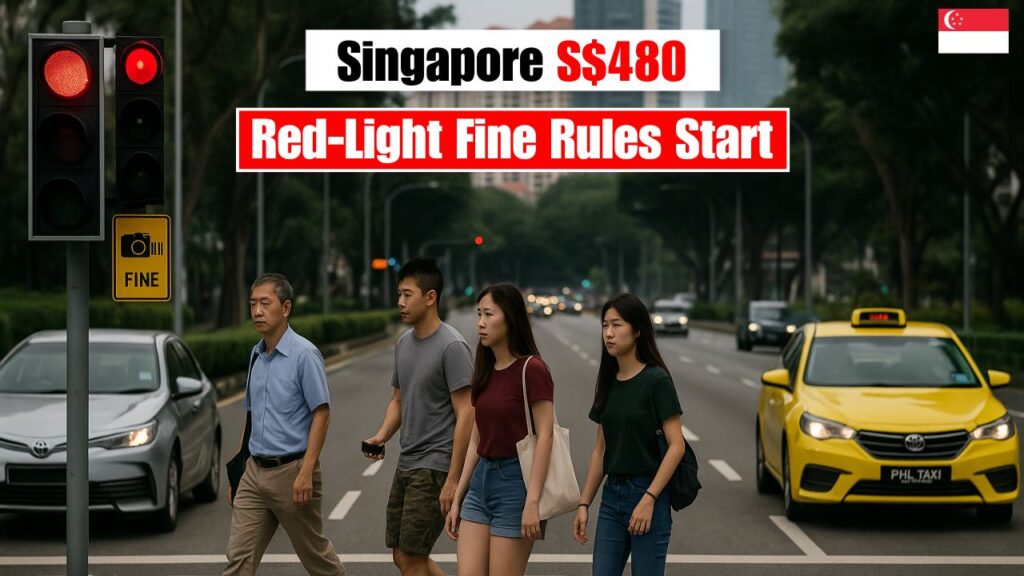
Singapore is preparing for a major shift in road safety enforcement as new AI-powered red-light monitoring rules take effect from 10 December. Under these enhanced measures, drivers caught beating the red light may face penalties of up to S$480, marking one of the strictest updates in recent years across the country. The initiative aims to reduce intersection accidents, improve public road discipline, and support safer travel for all motorists. With advanced cameras and automated detection systems, Singapore’s transport authorities hope to encourage more responsible driving behaviour throughout the city-state.
AI Red-Light Penalties Introduced for Singapore Drivers
Singapore’s newly expanded AI red-light system brings stricter enforcement to intersections where violations frequently lead to serious accidents. The government’s latest move signals a strong effort to reduce risky driving through automated detection tools, intersection safety upgrades, and high-accuracy monitoring. These upgraded cameras are capable of identifying vehicles that cross the line even moments after the signal changes, helping authorities reduce repeat offences. Drivers are advised to stay alert, slow down when approaching traffic lights, and avoid last-second decisions that could result in costly penalties. With the S$480 fine in place, officials hope to lower collision risks in busy districts.

Stricter Enforcement Rules Under New Penalty Framework
The penalty framework launching on 10 December incorporates stronger enforcement protocols that work hand-in-hand with AI systems. Motorists should expect real-time violation tracking, enhanced video analytics, and consistent rule application across Singapore’s busiest junctions. These technological upgrades ensure that enforcement remains fair, transparent, and comprehensive, catching instances that might otherwise go unnoticed. Drivers who unintentionally accelerate during amber lights may also face penalties if the AI determines unsafe behaviour. By establishing clearer guidelines and automated reviews, the authorities aim to close enforcement gaps and reduce intersection-related road injuries.
How the New S$480 Red-Light Fine Affects Motorists
With the introduction of S$480 red-light penalties, motorists must be more conscious of their driving patterns, especially during peak traffic hours. The updated system emphasises driver behaviour monitoring, road safety compliance, and predictable enforcement outcomes to create a safer road culture. While the fine amount may feel steep to some, it is designed to discourage dangerous manoeuvres that can put pedestrians and drivers at risk. Motorists are encouraged to stay calm, maintain proper braking distance, and approach signals with caution. Ultimately, the financial deterrent aims to strengthen accountability and reduce hazardous driving.
 SA Salary Tax Change for 2025: Workers Could Save Up to R4,500 — Update Before 15 December
Summary and Road Safety Outlook
Overall, the new AI-driven red-light enforcement rules reflect Singapore’s commitment to safer, smarter transportation networks. By integrating advanced enforcement systems, predictive safety tools, and data-driven oversight, the government hopes to substantially reduce accidents caused by signal violations. The S$480 penalty serves as both a deterrent and a reminder for drivers to adopt mindful habits behind the wheel. As Singapore continues modernising its transport infrastructure, motorists can expect more AI-based safety initiatives to emerge in the coming years.
| Key Feature | Description |
|---|---|
| Start Date | 10 December 2025 |
| Maximum Penalty | S$480 for violations |
| Technology Used | AI-powered detection cameras |
| Main Objective | Reduce red-light accidents |
| Target Areas | High-risk intersections |
Frequently Asked Questions (FAQs)
1. When do the AI red-light rules start?
The new rules officially begin on 10 December 2025.
2. What is the maximum penalty for offenders?
Drivers may be fined up to S$480 for a red-light violation.
3. How does the AI system detect violations?
It uses automated cameras and advanced analytics to identify offenders.
4. Why is Singapore tightening red-light enforcement?
The goal is to reduce collisions and improve overall road safety.